Director’s Close: Up Thrill Seekers: Directing Dynamic Genre
March 7th, 2019
With a new generation of critically acclaimed genre films making big bucks and becoming indispensable internet memes, ever wonder why certain movies just seem to keep you on the edge of your seat more than others? The final night of the 2019 DCU features a crack team of cutting-edge midnight movie mavericks, whose collected works have shocked and thrilled millions of audience members the world over.
Director’s Close Up: Thrill Seekers: Directing Dynamic Genres
By Gerry O., KIDS FIRST! Film Critic, Age 16
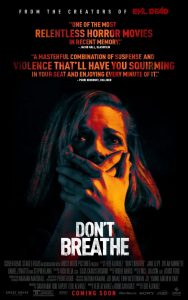
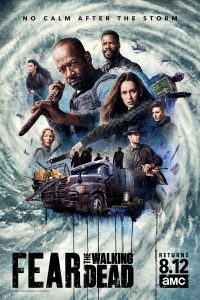
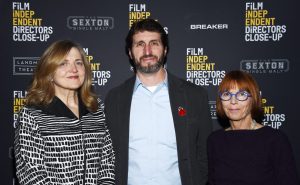
In the cloudy evening of February 27, 2019, Film Independent hosted the final panel of their month-long event, Director’s Close-Up. The event featured many directors in the horror genre such as Fade Alvarez (writer/director, The Girl in the Spider’s Web, Don’t Breathe), Drew Dowdle (writer/producer, Waco, Quarantine), John Eric Dowdle (writer/director, Waco, Quarantine), Aaron Katz (writer/director, Gemini, Land Ho!) and Daniel Stamm (director, Fear the Walking Dead, The Last Exorcism). The panel was moderated by Scott Mantz (film critic, Collider).
These filmmakers had no interest in monsters, giant bugs, ghosts, or ghouls. They all wished to invest their time into a much deeper side of terror. Alvarez’s Don’t Breathe made the audience afraid to move or make a sound. Drew and John Dowdle’s As Above causes viewers to feel claustrophobic, struggling to breathe and wishing for more room. While it may seem simple to terrify an audience, Stamm pointed out a fundamental crux of horror filmmaking: There is only a finite amount of methods to scare someone, causing a completely brand-new concept in horror to be a rare sight.
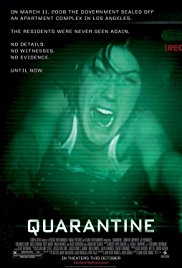
Horror has also been the place for many directors with smaller budgets to undertake. Drew and John attempt to make their film like a business for investors. They illustrate a detailed step-by-step plan that allows the film to have high chances of making a profit. Their strategy gives investors a clear end goal, motivating them to contribute to the film. They did add though, that a smaller budget can perhaps make a film even more terrifying, since the crew cannot afford to actually show what causes the fear. Merely hinting at the presence of something can greatly increase the intensity. Katz thought that dealing with a low-budget properly can make the film even more exciting and Stamm believed that a micro-budget and no budget gives you true creative freedom to do what you wish instead of running after investors. After receiving funding, all filmmakers go through a lengthy period of pre-production, but the exact details of what should occur in pre-production differed between panelists.
Alvarez personally only does storyboards if it works for the crew, such as a car crash that requires careful planning and coordination. The Dowdles similarly both opt to do them, depending on what the scene has and they also added that they only show storyboards to department heads. Showing it to all the crew can lead to confusion if the director decides to skip or modify a shot. Katz prefers a different method entirely – overheads of the scene. He likes to go to the location where filming is taking place and see how the different shots of the scene work with each other. After planning and filming a movie, a filmmaker must now complete the tedious process of editing the project.
While most consider the film to be fully put together in the editing room, Alvarez believes that editing can only do so much. Production and pre-production make the film. No amount of editing can drastically raise the quality of the film. Drew Dowdle believes three films are being made – one in pre-production, one in production and one in post-production. Drew and John Dowdle added that you cannot begin to think about sound design until the editing room. In horror, sound makes up at least 50% of the quality of a movie. Alvarez’s Don’t Breathe and the year-old A Quiet Place by John Krasinski demonstrate the power of sound. In both films, the audience becomes terrified of every noise that comes from the screen. But this amount of intensity and fear only exists with masterful sound design and editing.

The panel added some important lessons for all filmmakers. Drew and John Dowdle stated that, “as a filmmaker, you cannot work on a film focusing on making money back, but must focus on the craft of cinema itself.” Stamm added the important lesson that many indie and new filmmakers attempt to make a movie look as close to “Hollywood style” as possible. In truth, good films are those that stand out and look different from the norm. The panel showcased the intricate art involved in causing fear in movies and the many lessons to learn when trying to create a film.
Film Independent’s Director’s Close Up series, as a whole, truly showcases the deep complexities of being the director of a film and how much goes into making each film we enjoy on the screen.






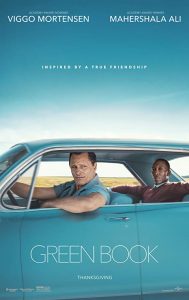 Dr. Don Shirley is a world-class African-American pianist who’s about to embark on a concert tour in the Deep South in 1962. In need of a driver and protection, Shirley recruits Tony Lip, a tough-talking bouncer from an Italian-American neighborhood in the Bronx. Despite their differences, the two men soon develop an unexpected bond while confronting racism and danger in an era of segregation. KIDS FIRST! Reviewer Kimbirly O. comments, “American History is often not pretty. When it comes to Green Book, it is purely ugly and lovingly told. From the stereotypical Italian-American neighborhood of the Bronx in New York, to the Deep South during the 60s, this film is based on a true story of unlikely friends. See her full review below.
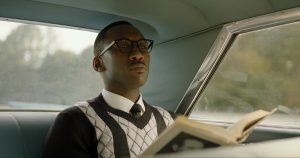 Tony “Lip”, not Tony the Lip, mind you, is a family man. He, like his father before him, is a hard-working proud Italian man, who lives in the same neighborhood as the generations who came before him. He is married (his wife is played by Linda Cardellini)) and they have two sons. He prides himself on being a “bullshit artist.” When he loses his job, he is recruited to serve as the driver to a renowned pianist, who just so happens to be African-American. Dr. Shirley, on the other hand, is estranged from his family and searching. The two men are cast perfectly and bring the best both offer and then some. There are some very touching scenes within this film.
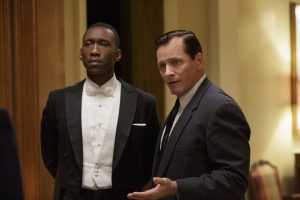 cial stereotypes prevalent throughout the film, instead I will focus on the unlikely friendship, which continued throughout the lives of both men. This film is based on a true story. It is co-written by Nick Vallelonga (Tony’s son), Bryan Currie and Peter Farrelly, who is best known for films written with his brother Bobby and more sophomoric in nature (i.e. Dumb and Dumber). Peter Farrelly also directs the film.
 I give this film 4.5 out of 5 stars and recommend it for ages 12 to 18, as well as adults. There is a LOT of smoking, I mean SO MUCH SMOKING. It takes place in the 60s and everyone seems to smoke. There is also a lot of drinking in the film. Racism is prevalent throughout as it takes place in the Deep South where people were referred to as “colored” and segregated. There is also a brief scene, which intimates a sexual encounter between two men, although there is no true nudity. This film opens in theaters nationwide November 16, 2018. See it! Stay for the credits.
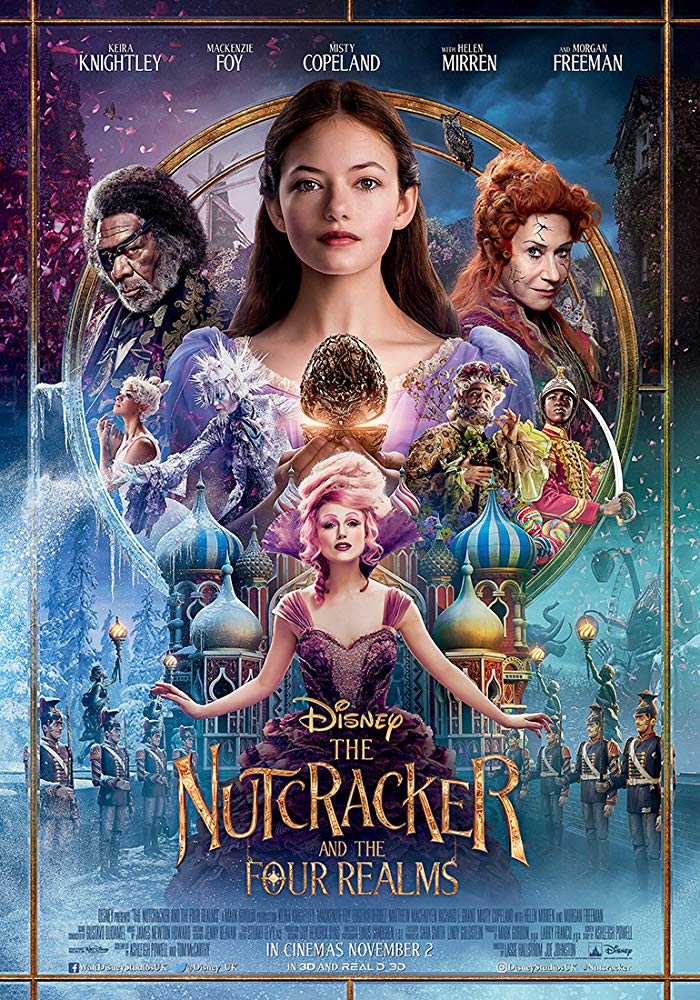 All Clara wants is a key – a one-of-a-kind key that will unlock a box that holds a priceless gift from her late mother. A golden thread, presented to her at godfather Drosselmeyer’s annual holiday party, leads her to the coveted key-which promptly disappears into a strange and mysterious parallel world. It’s there that Clara encounters a soldier named Phillip, a gang of mice and the regents who preside over three Realms: Land of Snowflakes, Land of Flowers, and Land of Sweets. Clara and Phillip must brave the ominous Fourth Realm, home to the tyrant Mother Ginger, to retrieve Clara’s key and hopefully return harmony to the unstable world. Kimbirly O., KIDS FIRST! Juror comments, “From the beginning of the film, your senses will be ALIVE! Every set looks edible with color and life. Truly, this live-action Disney film is a breath of fresh air.” See her full review below.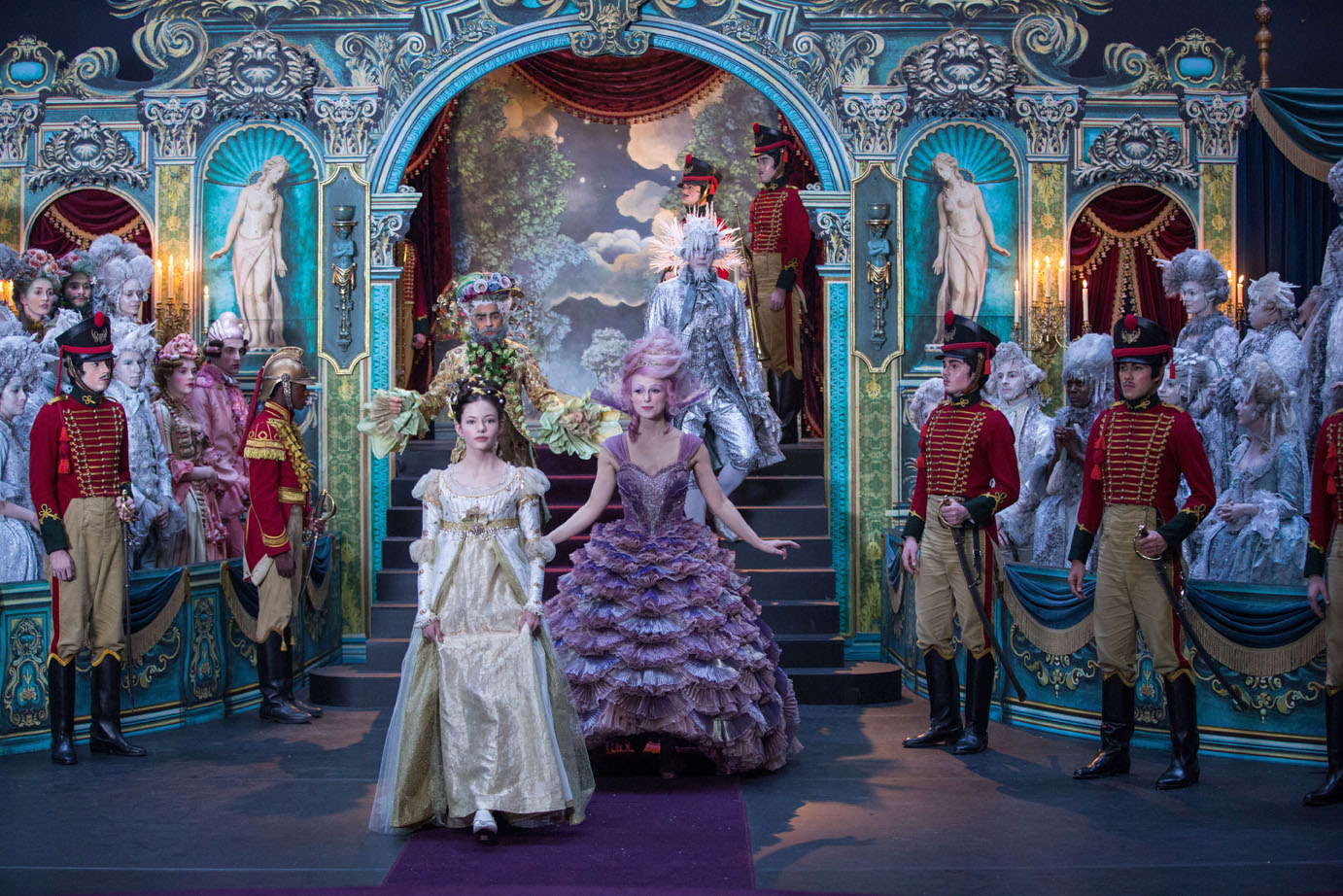

 and mysterious parallel world. From one world to the next, Land of Snowflakes, Land of Flowers and Land of Sweets, Clara and a soldier she meets named Phillip (Jayden Fowora-Knight) must brave the ominous Fourth Realm, home to the tyrant Mother Ginger (Helen Mirren), to retrieve Clara’s key.
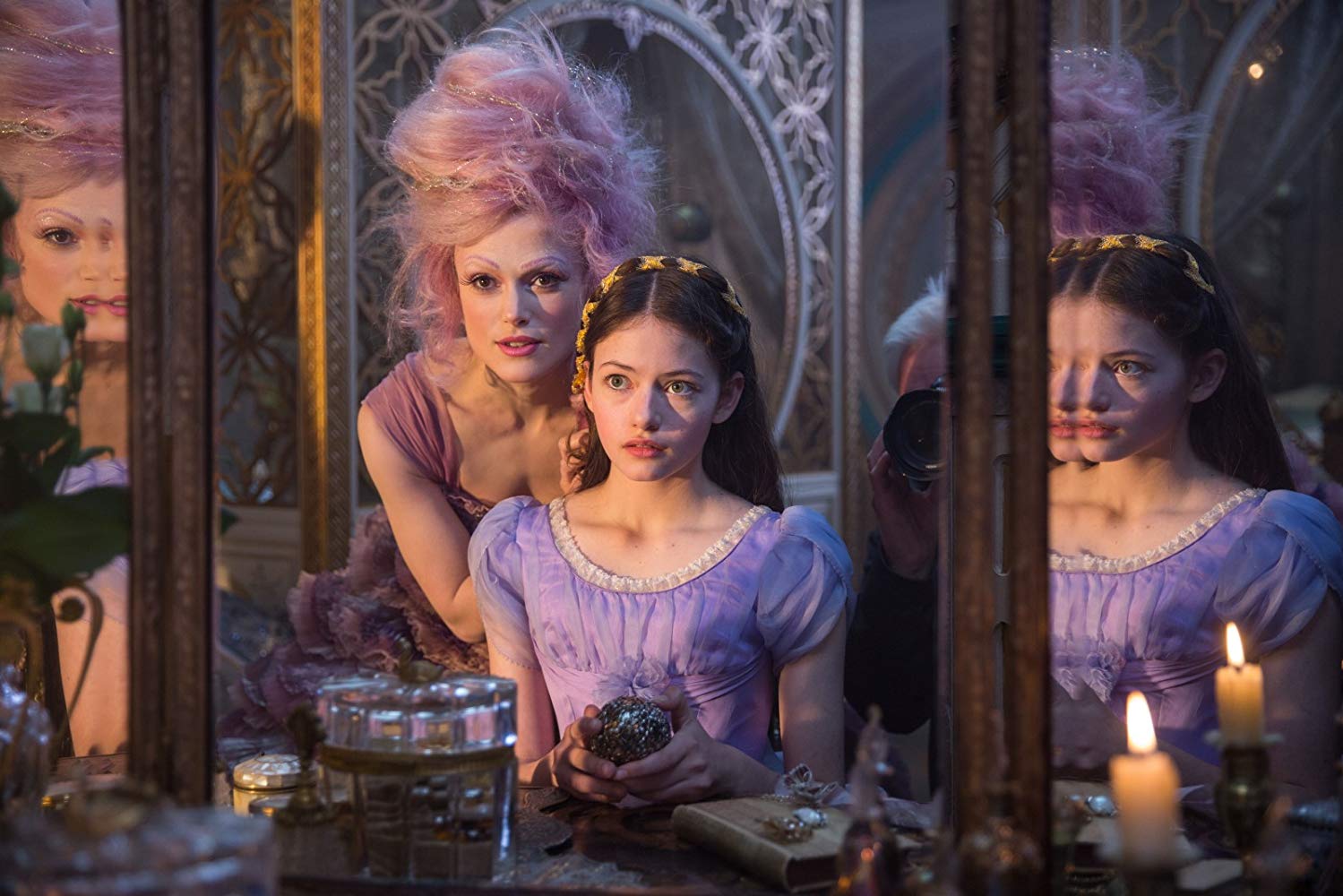 5 stars and recommend it for ages 4 to 18, as well as adults. You should know this film deals with the death of a parent. It opens in theaters nationwide November 2, 2018. Look for it! You’ll be glad you did.
 From award-winning filmmaker Dan Habib comes Intelligent Lives, a catalyst to transform the label of intellectual disability from a life sentence of isolation into a life of possibility for the most systematically segregated people in America. Intelligent Lives stars three pioneering young American adults with intellectual disabilities – Micah, Naieer, and Naomie – who challenge perceptions of intelligence as they navigate high school, college, and the workforce. Academy Award-winning actor and narrator Chris Cooper contextualizes the lives of these central characters through the emotional personal story of his son Jesse, as the film unpacks the shameful and ongoing track record of intelligence testing in the U.S. Intelligent Lives challenges what it means to be intelligent, and points to a future in which people of all abilities can fully participate in higher education, meaningful employment and intimate relationships.
 of determination to contribute to society regardless of the label of “intellectual disability”. We follow three young adults through their personal journeys to make a life for themselves. They had me rooting for them throughout the entire film. I admire their chutzpah and determination.
 bility once known as “mentally retarded” into a life of possibility. We watch Naieer, Micah and Naomie as they work through high school, college and the workforce to accomplish their goals. Micah, born in 1984, is determined to succeed. He goes to Syracuse University and graduates with a certificate from the school of education to become a teaching assistant. He gives us a new outlook and perspective on someone with an IQ of 40, being quite savvy with social media. He is a constant reminder not to underestimate what people can do. After college, he learns to live on his own and becomes close with a fellow classmate, Meghan and helps her to advocate for herself.
 Naieer, born in 1999, has a great talent for art, takes general education in inclusion classes, and is a great basketball player at a public high school in Massachusetts. Through the Art for Cultural Inclusion show, he creates six wonderful paintings. Naomie is 25, loves to sing and dance at her church in Rhode Island with her hip-hop producer brother, and works toward and gets her first paying job through a job training program at a hair salon.
 per and his wife Marianne as they share the connection to the film and tell us about their son Jesse, whose intelligence has been questioned because he has cerebral palsy. Jesse however, became a high school honor student and a poet, before his death at age 17.
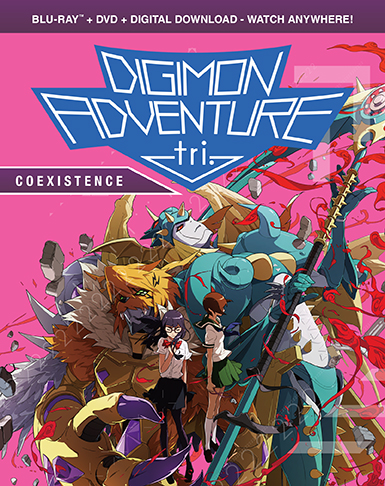 The Adventure Continues…The arrival of the super powerful Meicoomon starts a countdown to the real world’s collapse. The DigiDestined are cast out of the Digital World, and even after returning to the real world, are driven away by people, due to their partnerships with the Digimon. Meanwhile, a cruel fate appears imminent for Kari, who has a more honest and sensitive spirit than anyone. KIDS FIRST! Adult Juror Kimbirly M. comments, “With the well-known Japanese anime style, Digimon-tri has sharp-edge graphics and action sequences that draw the viewers in.” See the rest of her review below.
 This is a continuation of the popular Digimon-tri series. The storyline, generally about dark forces taking over, flows well. There are no lagging sequences that would bore the viewer. One becomes empathetic with the protagonist Kari and even the evil force overtaking Meicoomon. The vocabulary and concepts are appropriate for its intended age group and could further enhance vocabulary and concepts that the viewer may not understand. It portrays pro-
 social models such as when Kari feels that she might be responsible for a specific situation and one of the others reassures her that this definitely isn’t the case. This entire series is very good at displaying consequences of both negative and positive behaviors. There are also good models of problem solving such as when a Digimon character decides on an action and another vehemently opposes it. The rest of the group has to come to a general consensus to make a final determination.
 s. Life has complicated challenges, but you can overcome them. You should be aware that there are two things that make this more appropriate for older viewers. First, a character pulls out a gun, but there is no blast. And second, we see a powerful being shaped like a naked woman, although there are no graphic features. For that reason, I recommend it for ages 10 to 18, as well as young adults and give it 4 out of 5 stars. I would raise the highest age to 25 if I could, because it is so thought-provoking and intelligent. The DVD allows you to select specific scenes and has a bonus feature interview. Reviewed by Kimberly M., KIDS FIRST! Adult Reviewer


