Molly of Denali * Delightful and Authentic Portrayal of Three Generations of Native Americans
Wednesday, October 16th, 2019
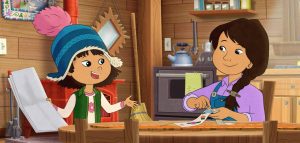
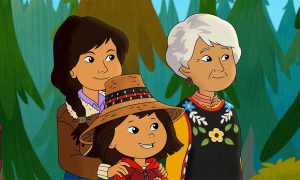
Molly of Denali is an American-Canadian animated television series created and produced by Atomic Cartoons and WGBH Kids for PBS Kids and CBC Television. It premiered on July 15, 2019. The series is the first ever nationally distributed children’s show to feature an Alaska Native as the main character and protagonist. Thirty-eight half-hours have been ordered. Between the two 11-minute story segments, there is a special live-action segment filmed in Alaska. The series follows 10-year-old Molly, an Alaska Native girl from the fictional village of Qyah, and her family, friends Tooey and Trini, her dog Suki, and other residents. Her family runs the Denali Trading Post. It was created by Dorothea Gillim and Kathy Waugh and stars Sovereign Bill. The Molly of Denali theme song is sung by Phillip Blanchett and Karina Moeller. KIDS FIRST! Adult Juror, Terry S. comments, “This animated show is truly delightful and quite authentic in portraying three generations – grand parents, parents and children. The images are true to form and culture.” See her full review below.
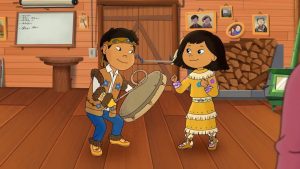
Molly of Denali – Grandpa’s
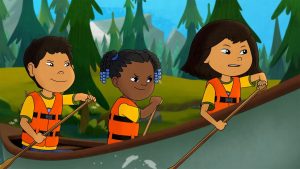
Drum and Have Canoe Will Paddles (TV series)
By Terry S., KIDS FIRST! Adult Juror
Molly of Denali is an animated TV series featuring a strong
Native American 10-year-old girl from Alaska.
The show I watched has two 11-minute episodes: Grandpa’s Drum and Have
Canoe will Paddle. The focus is on problem solving, while incorporating
literacy and technology skills.
Alaskan Native values are modeled including respect, sharing, team work and
honoring elders, family and cultural awareness.

The program highlights a Native American community in Alaska. The lead character Molly is a strong, energetic young girl, full of life and an inquiring mind. In Grandpa’s Drum, she and Tuli find an old photograph of her grandpa when he was young together with a young girl. They discover he doesn’t like to sing anymore, because he no longer has his drum. They go on a quest to find the girl and his drum by using their research skills. In Have Canoe Will Paddle, Molly, Tuli and Trini get resourceful once again with their literacy skills to learn how to paddle a canoe. With their friendly social skills, they find an appropriate coach to teach them, so they can enter a race.

Native Alaskan children will proudly see themselves and their way of life and a broader audience will be introduced to a new culture. They will experience adventures with the lead characters and see their contemporaries problem solving, learning and having fun. In Grandpa’s Drum, they will see Molly and Trini singing and their Grandpa remembering songs with his drum and teaching them. In Have Canoe Will Paddle, they will see the steps Molly and friends make to learn how to canoe and master the race. They will learn to know that we are more alike than different. Viewers may be motivated to explore their own cultural backgrounds as a result.
This is a very engaging show with fun characters that are eager to learn. Each episode flows well, incorporating literacy and technology skills that young children can relate to. It encourages them to go out and learn the skills they need to problem solve and have fun while doing so.

Young children, parents, teachers and caregivers alike will learn about the Native Alaskan culture and learn new Native vocabulary, as well as the difference between now and then. In Grandpa’s Drum, we learn that when he was a young boy, he had to go to boarding school and was not allowed to celebrate his culture at school. Today, we find out that this does not happen. Children are at home going to school and can celebrate their culture. This animated show is truly delightful and quite authentic in portraying three generations – grand parents, parents and children. The images are true to form and culture.
In addition to the two animated shorts in each episode, there is a live action piece. In this episode, Molly answers questions about life in Alaska. We see children who live there at the river comparing old photographs of a similar place and see what it looks like today. They learn a traditional song from an elder. One girl says, “When I am dancing with ancestors, I connect with the past.”

Molly of Denali has all the benefits of inviting the viewer to question, probe and problem solve as described above, while introducing the viewer to a new culture and environment. It encourages one to look into situations such as in Grandpa’s Drum when it helps him to reconnect with his youth, re-learning the songs he loved with his new found drum, and then teaching and passing them on to the younger generation. Viewers will be motivated and encouraged to explore their own cultural backgrounds. Similarly in Have Canoe Will Paddle where it shows how one can learn a new sport, if they so desire. The role modeling of determination is inspiring.
The moral of the series is: if there is a will, there is a way as it models problem solving to get the results you want, gaining new skills and having fun while doing it! Molly and her friends are terrific, inspiring role models for young children to get excited about learning!
I give this series 5 out of 5 stars and recommend it for ages 4 through 8. This airs on PBS Kids and CBC Television now, so look for it. Reviewed by Terry S., KIDS FIRST! Adult Juror.


Dr. Don Shirley is a world-class African-American pianist who’s about to embark on a concert tour in the Deep South in 1962. In need of a driver and protection, Shirley recruits Tony Lip, a tough-talking bouncer from an Italian-American neighborhood in the Bronx. Despite their differences, the two men soon develop an unexpected bond while confronting racism and danger in an era of segregation. KIDS FIRST! Reviewer Kimbirly O. comments, “American History is often not pretty. When it comes to Green Book, it is purely ugly and lovingly told. From the stereotypical Italian-American neighborhood of the Bronx in New York, to the Deep South during the 60s, this film is based on a true story of unlikely friends. See her full review below.
Tony “Lip”, not Tony the Lip, mind you, is a family man. He, like his father before him, is a hard-working proud Italian man, who lives in the same neighborhood as the generations who came before him. He is married (his wife is played by Linda Cardellini)) and they have two sons. He prides himself on being a “bullshit artist.” When he loses his job, he is recruited to serve as the driver to a renowned pianist, who just so happens to be African-American. Dr. Shirley, on the other hand, is estranged from his family and searching. The two men are cast perfectly and bring the best both offer and then some. There are some very touching scenes within this film.
cial stereotypes prevalent throughout the film, instead I will focus on the unlikely friendship, which continued throughout the lives of both men. This film is based on a true story. It is co-written by Nick Vallelonga (Tony’s son), Bryan Currie and Peter Farrelly, who is best known for films written with his brother Bobby and more sophomoric in nature (i.e. Dumb and Dumber). Peter Farrelly also directs the film.
I give this film 4.5 out of 5 stars and recommend it for ages 12 to 18, as well as adults. There is a LOT of smoking, I mean SO MUCH SMOKING. It takes place in the 60s and everyone seems to smoke. There is also a lot of drinking in the film. Racism is prevalent throughout as it takes place in the Deep South where people were referred to as “colored” and segregated. There is also a brief scene, which intimates a sexual encounter between two men, although there is no true nudity. This film opens in theaters nationwide November 16, 2018. See it! Stay for the credits.
All Clara wants is a key – a one-of-a-kind key that will unlock a box that holds a priceless gift from her late mother. A golden thread, presented to her at godfather Drosselmeyer’s annual holiday party, leads her to the coveted key-which promptly disappears into a strange and mysterious parallel world. It’s there that Clara encounters a soldier named Phillip, a gang of mice and the regents who preside over three Realms: Land of Snowflakes, Land of Flowers, and Land of Sweets. Clara and Phillip must brave the ominous Fourth Realm, home to the tyrant Mother Ginger, to retrieve Clara’s key and hopefully return harmony to the unstable world. Kimbirly O., KIDS FIRST! Juror comments, “From the beginning of the film, your senses will be ALIVE! Every set looks edible with color and life. Truly, this live-action Disney film is a breath of fresh air.” See her full review below.

and mysterious parallel world. From one world to the next, Land of Snowflakes, Land of Flowers and Land of Sweets, Clara and a soldier she meets named Phillip (Jayden Fowora-Knight) must brave the ominous Fourth Realm, home to the tyrant Mother Ginger (Helen Mirren), to retrieve Clara’s key.
5 stars and recommend it for ages 4 to 18, as well as adults. You should know this film deals with the death of a parent. It opens in theaters nationwide November 2, 2018. Look for it! You’ll be glad you did.
From award-winning filmmaker Dan Habib comes Intelligent Lives, a catalyst to transform the label of intellectual disability from a life sentence of isolation into a life of possibility for the most systematically segregated people in America. Intelligent Lives stars three pioneering young American adults with intellectual disabilities – Micah, Naieer, and Naomie – who challenge perceptions of intelligence as they navigate high school, college, and the workforce. Academy Award-winning actor and narrator Chris Cooper contextualizes the lives of these central characters through the emotional personal story of his son Jesse, as the film unpacks the shameful and ongoing track record of intelligence testing in the U.S. Intelligent Lives challenges what it means to be intelligent, and points to a future in which people of all abilities can fully participate in higher education, meaningful employment and intimate relationships.
of determination to contribute to society regardless of the label of “intellectual disability”. We follow three young adults through their personal journeys to make a life for themselves. They had me rooting for them throughout the entire film. I admire their chutzpah and determination.
bility once known as “mentally retarded” into a life of possibility. We watch Naieer, Micah and Naomie as they work through high school, college and the workforce to accomplish their goals. Micah, born in 1984, is determined to succeed. He goes to Syracuse University and graduates with a certificate from the school of education to become a teaching assistant. He gives us a new outlook and perspective on someone with an IQ of 40, being quite savvy with social media. He is a constant reminder not to underestimate what people can do. After college, he learns to live on his own and becomes close with a fellow classmate, Meghan and helps her to advocate for herself.
Naieer, born in 1999, has a great talent for art, takes general education in inclusion classes, and is a great basketball player at a public high school in Massachusetts. Through the Art for Cultural Inclusion show, he creates six wonderful paintings. Naomie is 25, loves to sing and dance at her church in Rhode Island with her hip-hop producer brother, and works toward and gets her first paying job through a job training program at a hair salon.
per and his wife Marianne as they share the connection to the film and tell us about their son Jesse, whose intelligence has been questioned because he has cerebral palsy. Jesse however, became a high school honor student and a poet, before his death at age 17.