Kay Panabaker Joins the KIDS FIRST! Board
Monday, January 19th, 2009 As we enter a new year, we at KIDS FIRST! are excited to announce a new board member who is joining our team. Actress Kay Panabaker (“Fame,” “Nancy Drew,” “Moondance Alexander,” “The Suite Life of Zack and Cody” among others) has an intense interest in children and media.
CP: Please gives me a non-wikipedia view of how you see yourself and your goals.
KP: I see myself as a person who goes to the beat of my own drum. While most 18-year-olds are trying to appear more mature, I’m trying to hold onto my youth and innocence. Education, family, and hard work are often underrated in the media, but I hope that throughout my lifetime, I am able to impress upon people the significance of both of these in the lives of children. I hope to continue to work in jobs that I love and share that love with others.
CP: What made you want to be part of the KIDS FIRST! organization?
KP: As a 17-year-old UCLA graduate, education is clearly very important to me. Current pop culture has de-emphasized the value of education and family. The KIDS FIRST! organization has worked hard to celebrate children’s media that is both entertaining and instills good values in the audience. I think that with more support, they can create a safer and more child-friendly environment in the media. I continue to babysit, and I’m always looking for new movies and books to share with my charges that will encourage them to do great things in their lives.
CP: What do you feel you bring to board meetings and general function for KIDS FIRST!?
KP: I feel that my youth brings a new perspective to KIDS FIRST! adults who, while having more worldly experience, have to work harder in order to understand children trends and interests. I am constantly hanging out with kids and consider myself a big kid, so I think my experiences will help KIDS FIRST! I hope my familiarity with children and the things that they are interested in will help KIDS FIRST! find great children’s media.
CP: What was your impression of the board member you first met?
KP: While I haven’t met the rest of board, I have met Ranny Levy, and she has been so nice to me. We first met when she presented me with a KIDS FIRST! Film Award and I was immediately taken with how caring and kind she is. She is so very passionate about her cause, and I hope that I am able to help her in her endeavor to better the lives of children through media.
CP: Please tell us about an experience with children’s media that had a great impact on your life.
KP: I’ve always been a big of the Disney animated films. They are always so witty and funny and enjoyable for people of all ages. As a kid, and even as a teenager, I have looked at those films to help me figure myself out and investigate the world around me. I appreciate any book or movie that transports kids from their own lives to some other world.
CP: Do you plan to continue acting, pursue a teaching career? Both? Neither?
KP: I would like to continue acting as long as possible. The business is so finicky, however, that teaching is one of my backup plans. If I stop working as an actress, either by choice or lack of jobs, I will get my teaching credentials and hopefully teach elementary school. I actually just took and passed the CBEST, which allows me to substitute teach in California. I might try that and see how it goes.
CP: What changes would you like to see in children’s media in the future?
KP: I would love to see children’s media revert back to educational and family values. With the constant bombardment of media that has no value beyond entertainment, I want to see kid-safe media options that aren’t going to jeopardize their morals and their values. Adults need to understand that even the simplest things can have the biggest impact on children’s lives.
CP: Where you see KIDS FIRST!, as an organization, headed in the the future?
KP: I see KIDS FIRST! as becoming the measurement by which media judges its positive impact on children.
 1.Martino’s journey from art school in Ohio to Monty Python to “Ice Age” to “Horton Hears a Who.”Martino was bitten by the animation bug in animation class in college while studying to be a designer. He realized that he could move an audience with moving graphics and he enjoyed making people laugh. In the early 1980’s, he worked for television stations doing animations for the Super Bowl, NFL and ESPN. He found himself moving along with technology and its leaps and bounds. Back in the 80’s he would never have dreamed of feature films with characters like today. One of Martino’s favorite parts of his job is that he is lucky to work with talented people A highlight of his career was sitting with Terry Giliam at studio and story-boarding. Martino thinks Giliam is “one of most creative guys out there.” He had a huge influence of Martino. For instance, Martino was inspired by stories on how Martino made “Brazil” and how they used clacking in “Holy Grail” as a necessity since the film budget didn’t include horses. Working on a variety of film from “Holy Grail” to”Ice Age” and “Robots,” where he was art director, Martino gained the experience necessary for co-directing “Horton Hears a Who” along with Jimmy Hayward.2. Goals for the filmMartino had three major goals for this film. First, they wanted to adapt the book by a beloved, respected author, and remain true to the work in storytelling while expanding what was between the pages.The second film goal was the animation. They wanted to create flexibility and movement. The character development team challenge. As a team they worked together to create the perfect tools for animators to move characters around mixing creativity with technology, making the animation fluid.Thirdly, they wanted to keep true to the style. Dr. Seuss was production designer in Steve’s opinion. They promised Audrey Geisel, the widow of Ted Geisel (a.k.a. Dr. Seuss) that they would stay true to the style. According to Martino, one of best moments in the project was when he had lunch with Geisel after the project was complete and they and saw it in a special showing in a theatre. Martino laughs about how his hands were clenched on seat throughout the film, as if her were in a dentist chair, wondering how she would react. Before the credits even rolled, she stood up and applauded and commented that they took the story and lifted it to a new place. Martino expresses that it was the pinnacle of the filmmaking experience to sit with Audrey and have her applaud what they had done.3. Animating “Horton Hears a Who”Hayward and Martino both sat down to talk about the book and discovered that they agreed on how it should be portrayed. They discussed what they imagined as they read the book when they were kids. Martino also factored in ideas he developed as he read to his own kids, who are now 14- and 11-years-old. Hayward and Martino wanted to depict a sense of imagination — not like this world. They felt the story needed to be more exaggerated and imaginative than our world and came to the conclusion that to depict this, they would create a unique two-dimensional animation style.Computers like to keep things on model and perfect form, and for this project the creators wanted to push character distortion –heads squashed or arms 3 times a natural length. The art team jumped on this challenge and embraced it although it was difficult.The animation project was huge. They had a special fur team whose entire job was to groom the fur digitally. This task encompassed the Who’s and the plants. There were very complex scenes, which pushed technical boundaries such as the field of flowers near the end of the film which had ½ billion clovers. The animators managed to fill space and even have clovers blowing in wind. In order to do this they had to intelligently render clovers based on the camera angle through some technologicalingenuity. Each individual frame for this scene took two to three days. Due to the complexity of the scene, it took months to render.4.ResultsMartino firmly believes the film became what it is because of the talent of the people working on it. The cast, in his opinion, was phenomenal and the recording sessions took the movie to a place he never would have conceived of as the actors improvised and all the talented people contributed with their expertise.Three years on a film is a long time to be working on one project. Especially when you are a parent with two children. In fact, his two daughters are in the movie as Who voices, and they were also part of the focus group. Martino loved the great story and great theme by Dr Seuss — no prejudice. He found that this was a great investment of time and life, stating that it was “so nice to work on a project where you can bring your family to the film without hiding your head in shame.”
 “Ribert & Robert” is taking off! Since our
  The race is on again for famous contenders Wally the Tortoise and Murray the Hare when
 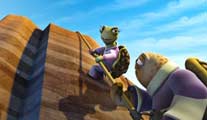 Sure to be a family-favorite with the humor and heart that The Jim Henson Company is known for, UNSTABLE FABLES: TORTOISE VS. HARE features a celebrity cast including the voice talent of Emmy Award® winner* Jay Leno (Ice Age 2), Danny Glover (Dreamgirls), Vivica A. Fox (Ella Enchanted), Keke Palmer (Jump In!, Akeelah And The Bee) and three-time winner of Kid’s Choice Award for Best Actor, Drake Bell (Superhero Movie, “Drake and Josh”).According to Lisa Henson, co-chief executive officer of The Jim Henson Company, the creators of Unstable Fables goal was to create a bookshelf series of unique versions of fairy tales. They endeavored to portray loose adaptations of the stories, showing the characters in modern ways. Above all, the tales were made to get audiences laughing and, based on the group of children I watched the film with, the creators met their goal.“Why did they decide to use animation instead of your trademark puppetry?” I asked Henson. The answer is that the Henson company is taking interest in 3-D animation and perhaps 2-D animation in the future.
 Henson has two children ages ten and eight who are already quite media savvy. She shares KIDS FIRST! values and the goal of providing quality entertainment for the kids. She also educates her children so they are media savvy and are informed viewers. Like many parents, Henson is concerned about what her kids watch, and she creates films such as TORTOISE VS. HARE with this criteria in mind. The Unstable Fables have a pro-family feel and use humor to engage children as well as adults. Her own children approved the film, especially since it starred some of their favorite actors (Keke Plamer and Drake Bell).As a producer, Henson was surprised at how well kids reacted to TV stars. According to her research, kids are much more likely to enjoy a film because of its TV stars than a film starring the voice of a movie star. In this series of Unstable Fables, they used stars kids could identify for the kids’ voices and stars parents enjoy for the adult voices to create all-age appeal.TORTOISE VS. HARE started out with a storyline very different from the final product. It didn’t have kids, and there was a lot more intrigue. Henson pointed out that when they began producing, they quickly realized that the series needed children in the stories. Families are a main focus with parents and children together. She also points out that she loves the new character designs, “Howard Baker did a really great job of developing an unstable way of finding characters—upbeat; cute, but not over-cute; modern—especially the tortoise with its jewel-encrusted shell.If you want a good laugh from a great story with superb visuals, check out TORTOISE VS. HARE, now on your store shelves. Fans of the series will also be pleased to know that the next Unstable Fable, GOLDILOCKS AND THE THREE BEARS hits the shelves later this year. What will the three bears do when Goldilocks moves in with them in a reality TV situation similar to “The Simple Life”?
 Our family has a new favorite film. “


