“The Velveteen Rabbit” – an Interview With Tim Nelson
Wednesday, February 11th, 2009 Our last newsletter highlighted a fantastic version of “The Velveteen Rabbit.” Here to tell us more about it is Tim Nelson, Creative Development Director from Feature Films for Families / New Movie Corp.CP: There are several film versions of “The Velveteen Rabbit” out there. What made you decide to cover it again, and what were some of the challenges you faced once you made this decision?TN: We wanted to make “The Velveteen Rabbit” an epic film for adults and children. Something for the silver screen that really felt bigger than life. Combining animation and live action was a challenge – how to write a story where we keep the classic 1900’s feel and are able to go in and out of those two worlds seamlessly without any gimmicky effects yet not be jarred back and forth. It worked.CP: The real-life mixed with animation was a real visual treat. Please tell me a bit behind the thought process behind the visuals (how did you come up with the ideas for the visuals and the animations)?A: The scenic design in the early stages was brilliant. Very talented artists painted backdrops that were a bit fantasy mixed with the new reality for Toby in a world he created as an escape. The other challenge was how to design the characters. We talked about going with a classic Winnie The Pooh style where at first the animation world was soft and pastel versus brilliant saturated colors but became more colorful as Toby’s imagination grew. While all were not all in full agreement, we resolved to brilliant saturated colors right from the get go. The general thinking was that we should go more contemporary with a 3D backgrounds and keep the characters in the attic traditional 2 dimensional. This business is all about give and take. Collaboration. All of us had to check our egos at the door.CP: Please tell me a bit about the animation process itself, such as what programs you used and what some of the the challenges were.TN: With all the waterfalls, rivers, underwater scenes, fires, flying and so on, we used so many softwares. Here’s a few: Maia, Adobe AfterEffects, Illustrator, Shake, Motion, The challenge was how to marry them all together. Some scenes had up to 30 or more layers so the time to render all those layers took a very long time. In the beginning we were planning on the animation taking 18 months. In the end it took over five years to finish.CP: Please give me an anecdote or description of something unexpected that happened during the filming process that made you grow as a producer.TN: That is a great question and a funny one, too. The little boy character Toby was only about 10 years old when we shot all the live action. By the time we finished the animation and the editing we needed to do some more voice work with him he was married and had children of his own. I’m kidding. But his voice had completely changed and he was about to finish high school. The moral of the story is mathematical. When you are told it will take “x” amount of time to do a project and “y” is the cost, here is the equation to figure out what it REALLY is going to take: (x= time) times 3 +(y= cost) times 4 + s (sweat) + p (patience) + a (agony) = end product. I still love this business.CP: What was your personal favorite part of the film and why?TN: As a boy, I always dreamed about flying so I loved that part. As an adult I really loved it when Grandmother’s cold and hard attitude started to warm up and soften a little with Toby. Sometimes, as a child, I felt adults didn’t understand me and I didn’t want to understand them. But like making the movie, life is about give and take and collaboration and patience. It is not easy being a child sometimes. As I have had cancer my three children have had to change and grow up a little faster. Because of this, they have much more compassion for others.CP: What are you hoping the audiences will get out of this film?TN: I hope they will get that “love really does make us all real.” Loving one another and treating others how we want to be treated is a key to happiness.CP: Why do you think this film is good for KIDS FIRST!?TN: I have always been such a big fan of KIDS FIRST! and “The Velveteen Rabbit” fits right in so perfectly with what KIDS FIRST! is doing. I love talking to KIDS FIRST! audiences as well. They are children who are very smart about watching movies, and I trust their opinions very much.CP: Is there anything you would like to add?TN: I love the line said by rabbit to Toby in the tree: “Just put your heart into it and the rest of you will follow” Isn’t that how we overcome fear?
 As we enter a new year, we at KIDS FIRST! are excited to announce a new board member who is joining our team. Actress Kay Panabaker (“Fame,” “Nancy Drew,” “
 1.Martino’s journey from art school in Ohio to Monty Python to “Ice Age” to “Horton Hears a Who.”Martino was bitten by the animation bug in animation class in college while studying to be a designer. He realized that he could move an audience with moving graphics and he enjoyed making people laugh. In the early 1980’s, he worked for television stations doing animations for the Super Bowl, NFL and ESPN. He found himself moving along with technology and its leaps and bounds. Back in the 80’s he would never have dreamed of feature films with characters like today. One of Martino’s favorite parts of his job is that he is lucky to work with talented people A highlight of his career was sitting with Terry Giliam at studio and story-boarding. Martino thinks Giliam is “one of most creative guys out there.” He had a huge influence of Martino. For instance, Martino was inspired by stories on how Martino made “Brazil” and how they used clacking in “Holy Grail” as a necessity since the film budget didn’t include horses. Working on a variety of film from “Holy Grail” to”Ice Age” and “Robots,” where he was art director, Martino gained the experience necessary for co-directing “Horton Hears a Who” along with Jimmy Hayward.2. Goals for the filmMartino had three major goals for this film. First, they wanted to adapt the book by a beloved, respected author, and remain true to the work in storytelling while expanding what was between the pages.The second film goal was the animation. They wanted to create flexibility and movement. The character development team challenge. As a team they worked together to create the perfect tools for animators to move characters around mixing creativity with technology, making the animation fluid.Thirdly, they wanted to keep true to the style. Dr. Seuss was production designer in Steve’s opinion. They promised Audrey Geisel, the widow of Ted Geisel (a.k.a. Dr. Seuss) that they would stay true to the style. According to Martino, one of best moments in the project was when he had lunch with Geisel after the project was complete and they and saw it in a special showing in a theatre. Martino laughs about how his hands were clenched on seat throughout the film, as if her were in a dentist chair, wondering how she would react. Before the credits even rolled, she stood up and applauded and commented that they took the story and lifted it to a new place. Martino expresses that it was the pinnacle of the filmmaking experience to sit with Audrey and have her applaud what they had done.3. Animating “Horton Hears a Who”Hayward and Martino both sat down to talk about the book and discovered that they agreed on how it should be portrayed. They discussed what they imagined as they read the book when they were kids. Martino also factored in ideas he developed as he read to his own kids, who are now 14- and 11-years-old. Hayward and Martino wanted to depict a sense of imagination — not like this world. They felt the story needed to be more exaggerated and imaginative than our world and came to the conclusion that to depict this, they would create a unique two-dimensional animation style.Computers like to keep things on model and perfect form, and for this project the creators wanted to push character distortion –heads squashed or arms 3 times a natural length. The art team jumped on this challenge and embraced it although it was difficult.The animation project was huge. They had a special fur team whose entire job was to groom the fur digitally. This task encompassed the Who’s and the plants. There were very complex scenes, which pushed technical boundaries such as the field of flowers near the end of the film which had ½ billion clovers. The animators managed to fill space and even have clovers blowing in wind. In order to do this they had to intelligently render clovers based on the camera angle through some technologicalingenuity. Each individual frame for this scene took two to three days. Due to the complexity of the scene, it took months to render.4.ResultsMartino firmly believes the film became what it is because of the talent of the people working on it. The cast, in his opinion, was phenomenal and the recording sessions took the movie to a place he never would have conceived of as the actors improvised and all the talented people contributed with their expertise.Three years on a film is a long time to be working on one project. Especially when you are a parent with two children. In fact, his two daughters are in the movie as Who voices, and they were also part of the focus group. Martino loved the great story and great theme by Dr Seuss — no prejudice. He found that this was a great investment of time and life, stating that it was “so nice to work on a project where you can bring your family to the film without hiding your head in shame.”
 “Ribert & Robert” is taking off! Since our
  The race is on again for famous contenders Wally the Tortoise and Murray the Hare when
 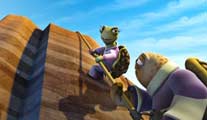 Sure to be a family-favorite with the humor and heart that The Jim Henson Company is known for, UNSTABLE FABLES: TORTOISE VS. HARE features a celebrity cast including the voice talent of Emmy Award® winner* Jay Leno (Ice Age 2), Danny Glover (Dreamgirls), Vivica A. Fox (Ella Enchanted), Keke Palmer (Jump In!, Akeelah And The Bee) and three-time winner of Kid’s Choice Award for Best Actor, Drake Bell (Superhero Movie, “Drake and Josh”).According to Lisa Henson, co-chief executive officer of The Jim Henson Company, the creators of Unstable Fables goal was to create a bookshelf series of unique versions of fairy tales. They endeavored to portray loose adaptations of the stories, showing the characters in modern ways. Above all, the tales were made to get audiences laughing and, based on the group of children I watched the film with, the creators met their goal.“Why did they decide to use animation instead of your trademark puppetry?” I asked Henson. The answer is that the Henson company is taking interest in 3-D animation and perhaps 2-D animation in the future.
 Henson has two children ages ten and eight who are already quite media savvy. She shares KIDS FIRST! values and the goal of providing quality entertainment for the kids. She also educates her children so they are media savvy and are informed viewers. Like many parents, Henson is concerned about what her kids watch, and she creates films such as TORTOISE VS. HARE with this criteria in mind. The Unstable Fables have a pro-family feel and use humor to engage children as well as adults. Her own children approved the film, especially since it starred some of their favorite actors (Keke Plamer and Drake Bell).As a producer, Henson was surprised at how well kids reacted to TV stars. According to her research, kids are much more likely to enjoy a film because of its TV stars than a film starring the voice of a movie star. In this series of Unstable Fables, they used stars kids could identify for the kids’ voices and stars parents enjoy for the adult voices to create all-age appeal.TORTOISE VS. HARE started out with a storyline very different from the final product. It didn’t have kids, and there was a lot more intrigue. Henson pointed out that when they began producing, they quickly realized that the series needed children in the stories. Families are a main focus with parents and children together. She also points out that she loves the new character designs, “Howard Baker did a really great job of developing an unstable way of finding characters—upbeat; cute, but not over-cute; modern—especially the tortoise with its jewel-encrusted shell.If you want a good laugh from a great story with superb visuals, check out TORTOISE VS. HARE, now on your store shelves. Fans of the series will also be pleased to know that the next Unstable Fable, GOLDILOCKS AND THE THREE BEARS hits the shelves later this year. What will the three bears do when Goldilocks moves in with them in a reality TV situation similar to “The Simple Life”?


